The digital frontier of low-strain pile integrity testing analysis
Written by Piletest
February 2026
The true challenge often lies not in fieldwork, but in the time-consuming, expertise-dependent task of analyzing the collected data
Low-strain integrity testing for deep foundation piles, standardized by ASTM D5882, has become an indispensable component of quality assurance for deep foundations across North America.
Its practical benefits, including relatively low equipment costs, minimal pile head preparation and short testing times, make it an ideal choice for testing all piles on large piling sites. However, as geotechnical professionals in Canada and elsewhere know well, the true challenge often lies not in fieldwork, but in the time-consuming, expertise-dependent task of analyzing the collected data.
The interpretation process, which involves analyzing wave-propagation signals captured at the pile head, provides a qualitative evaluation of the pile’s physical dimensions, continuity and material consistency, as well as the SPT levels of the ground in which it is constructed. Given the volume of data collected on large-scale infrastructure projects, the demand for timely and consistent analysis is always high.
This is where the emerging role of artificial intelligence (AI) and machine learning (ML) in geotechnical engineering, specifically for automating and validating the interpretation of low-strain integrity testing results, is becoming increasingly relevant.
The challenge of defining pile length
The determination of a pile’s actual length is one of the most critical and often uncertain parameters derived from low-strain integrity testing. For bored and cast-in-situ piles, the as-built length (LAsMade) is frequently unknown due to construction variables. The interpreted length (Lexpert) is directly tied to the wave speed assumed by the engineer, which is site-specific and unknown. Geotechnical engineers typically rely on published concrete correlations or an average site wave speed, which statistically is approximately 4,000 metres per second (+/- 10 per cent).
To enhance objectivity and efficiency, recent studies, such as the one presented in “Low-strain Impact Testing of Piles – AI Analysis,” have focused on training advanced computational models. This AI model was specifically designed to replicate and ultimately improve upon the human expert’s analysis of pile length from low-strain integrity testing data.
ML methodology
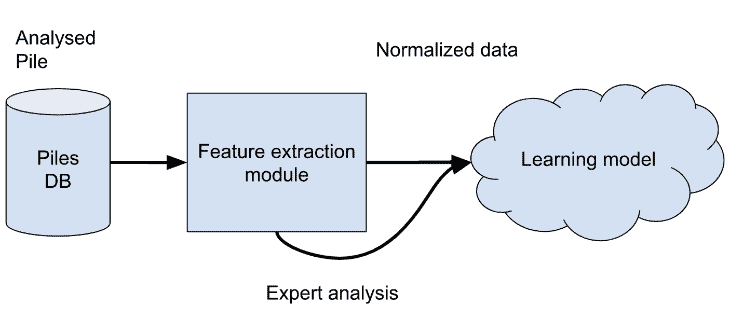
The development of a reliable AI model for low-strain integrity testing analysis begins with a robust training process, as illustrated in Figure 1. ML models are trained iteratively on vast datasets of inputs, in this case, raw accelerometer time series vectors, paired with the corresponding “target” output, which is the established Lexpert analysis performed by an experienced human. The model “learns” by continually minimizing the error, or “loss,” between its predictions and the human expert’s reported length.
Figure 1: Training phase
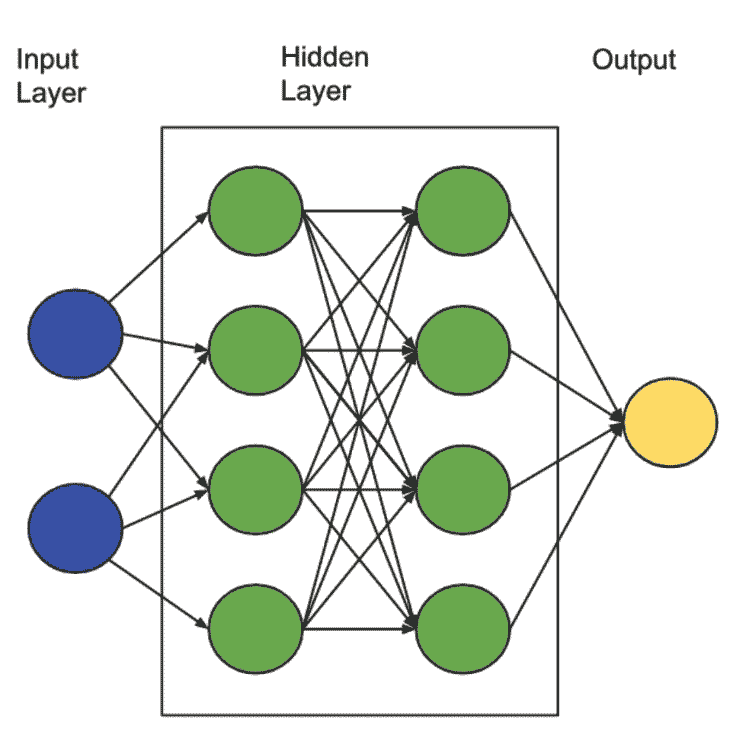
After testing various ML approaches, the researchers ultimately selected a deep learning network architecture (Figure 2) for its superior performance. The scale of the training data is crucial for accuracy. The model was trained on a database containing approximately 590,000 real test results collected by a professional testing agency with six field teams over 20 years.
Figure 2: Schematic deep learning network structure
However, raw field data is often too complex and noisy for effective ML. Consequently, several critical preprocessing steps were implemented to standardize the input:
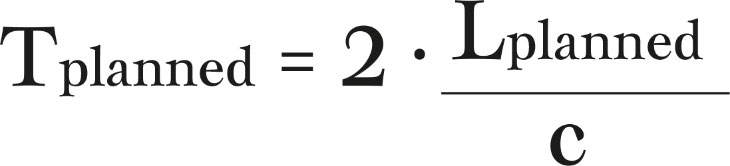
Time-only model: To eliminate the major unknown of the wave speed c (m./s), the planned pile length Lplanned [m] was converted into a time value Tplanned (s), using the relationship: This transformation simplified the prediction to a time-based reflection, removing the inherent variability of c as a separate variable during the core training process.
Data curation: A quick-reject script was used to flag and remove data with evident user-entry errors or extreme physical characteristics (for example, abnormally high amplification), resulting in the rejection of approximately 14 per cent of the raw data.
Standardized amplification and clipping: To ensure feature visibility, a consistent amplification function was applied to all time series. Furthermore, the data duration presented to the model was clipped to a small, relevant window past Tplanned, as longer traces primarily contain noise. The time series was then reduced to a manageable 100 data points to balance resolution and data size.
The development of a reliable AI model for low-strain integrity testing analysis begins with a robust training process.
Performance and practical utility
The trained AI model was validated on an independent set of roughly 110,000 previously unanalyzed test results. The results were highly encouraging, demonstrating a tight correlation (R2=0.9757) between the model’s predicted length (Lmodel) and the human expert’s analysis (Lexpert).
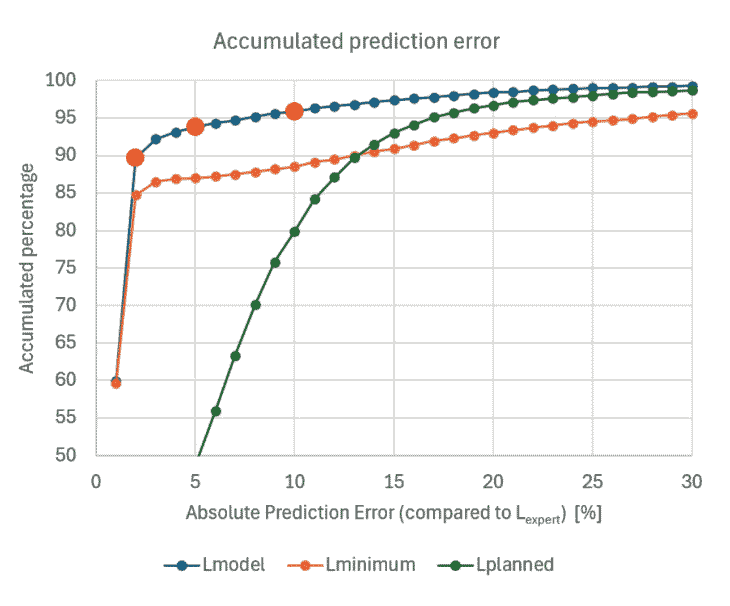
For Canadian geotechnical firms focused on quality assurance, the most compelling finding relates to the precision: the model’s Mean Absolute Percentage Error was found to be 1.6 per cent relative to the human expert’s prediction. In practical terms, this means that 90 per cent of the AI model’s length predictions were within two per cent of the experienced human analyst’s interpretation.
A critical comparison was made against simpler, or “naive,” prediction benchmarks, such as simply assuming the planned length (Lplanned) or identifying the deepest trough in the signal (Lminimum). The accumulated prediction error data, as shown in Figure 3, clearly demonstrates that the AI model significantly outperformed these naive predictors across all tolerance levels.
Figure 3: Comparing Lexpert Prediction error [percentage] to AI model Lmodel (blue), planned length Lplanned (green) and deepest trough Lminimum
The immediate implications for geotechnical practice are twofold:
Efficiency and consistency: A well-validated AI model can dramatically accelerate the initial analysis phase for large-scale projects, allowing technicians to rapidly process 100 per cent of tested piles and flag only a few problematic cases for detailed review.
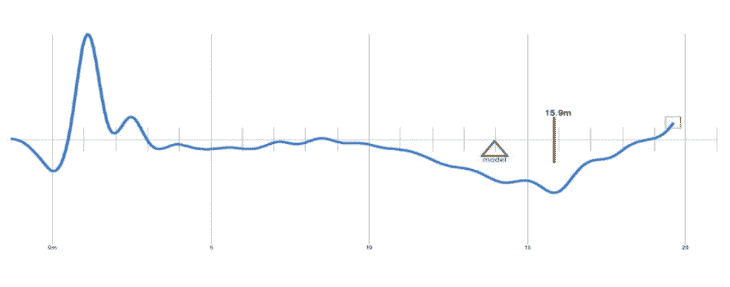
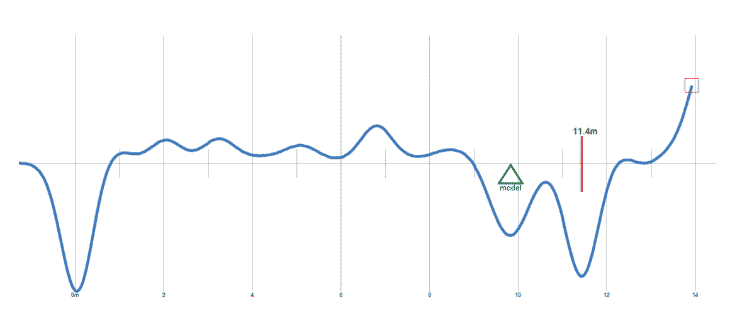
Quality control: The model can serve as a robust, non-subjective check against human error. A significant discrepancy between the AI’s prediction and a human analyst’s report (as shown in the study’s classification examples, such as Figure 4 and Figure 5) can trigger an immediate second-opinion review, thereby raising the overall quality and consistency of the integrity reporting process. Furthermore, the model presents a powerful tool for training novice analysts, offering a consistent, data-driven benchmark for learning wave interpretation.
Figure 4: “Wrong” example: Lmodel does not select the right location
Figure 5: “Inconclusive” example: On another day or another expert could have agreed with Lmodel
Future development and engineering judgment
These new AI capabilities will be introduced into the Pile Echo Tester from Piletest, which developed this research for AI measurement of pile length using the low-strain integrity testing method. While promising for length determination, AI augments rather than replaces engineers. Mistakes are inherent and require engineering judgment for soil-structure interaction, site conditions and complex anomalies.
Future development aims to identify impedance anomalies and categorize pile integrity (good, questionable, problematic, inconclusive) for automated preliminary assessments.
Integrating ML into non-destructive testing advances the deep foundations industry, offering higher efficiency, consistency and robust verification for Canadian infrastructure. Effective implementation demands collaboration among testing agencies, software developers and geotechnical engineers for diverse, high-quality data training.
Piling Canada is the premier national voice for the Canadian deep foundation construction industry. Each issue is dedicated to providing readers with current and informative editorial, including project updates, company profiles, technological advancements, safety news, environmental information, HR advice, pertinent legal issues and more.