

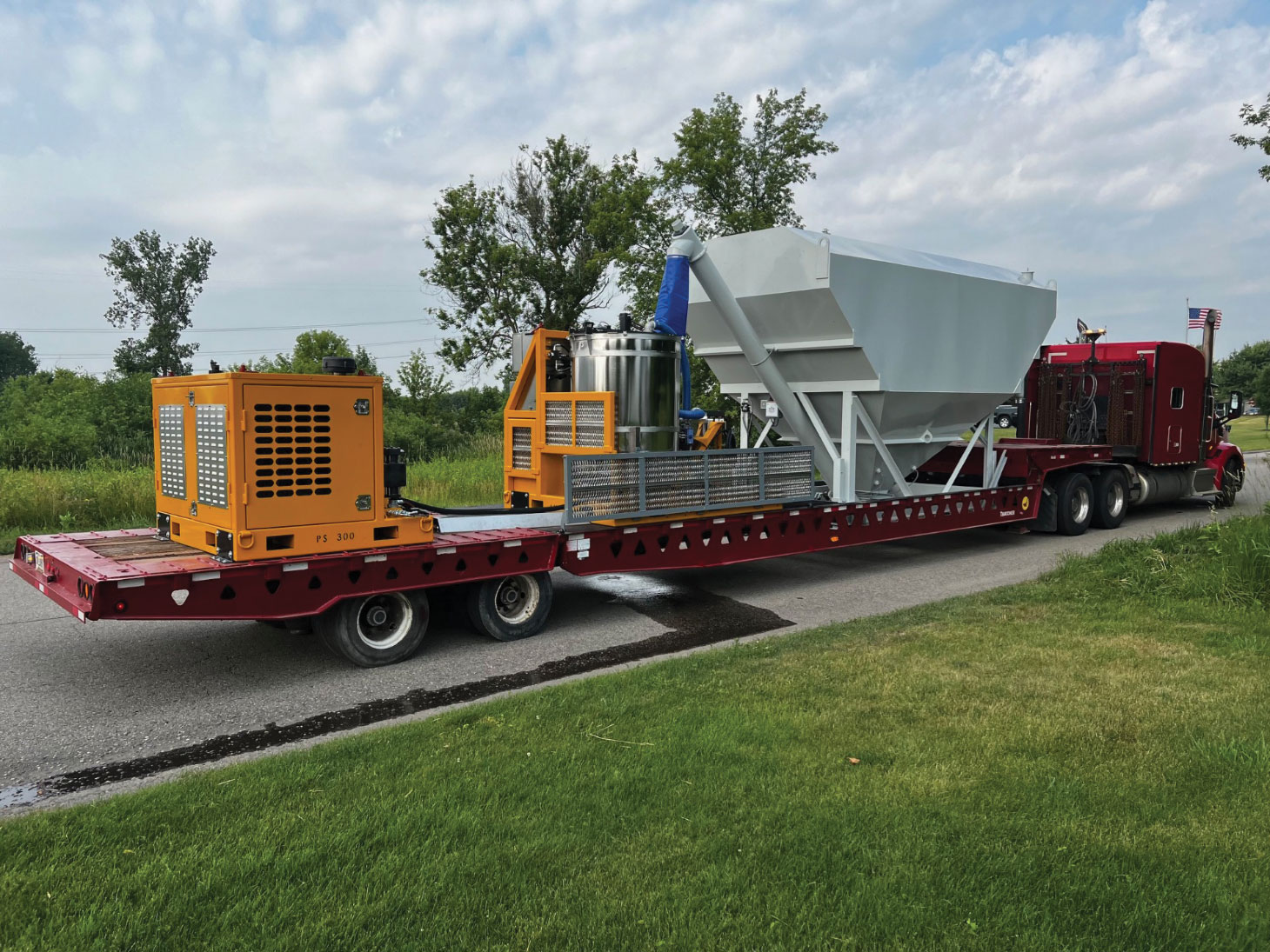
By combining the agility of a custom shop with the pedigree of former drillers, INTRIC is bridging the gap for high-performance grouting equipment in the Canadian market.
Drill rigs are the main force on deep foundation jobs. While experienced contractors know that drilling makes the hole, it is the grout that actually forms the structure. In 2017, Ben Vander Weide, president of INTRIC Grouting Solutions, Inc., noted a gap in North America’s grouting sector: European imports have long lead times and hard-to-find parts, while domestic options often lack needed sophistication.
Founded in Grand Rapids, Mich., INTRIC is now a key player in Canada’s piling industry, blending custom flexibility with strong engineering.
Born from necessity
INTRIC was created out of industry frustration and lack of manufacturer support, which Vander Weide witnessed as an equipment dealer. According to him, INTRIC’s sister company, National Piling Products Inc. (NPPI), was the dealer for Obermann, a well-known German grouting equipment manufacturer.
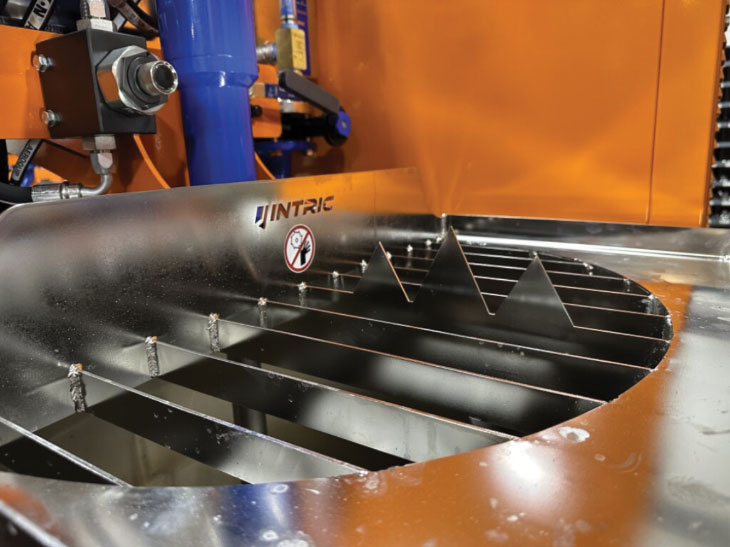
He says when Obermann went through transitions in ownership, NPPI was having a hard time with parts, local service and support. Most of their customers gave them feedback on how to improve the machines. “There were a lot of distributors with limited knowledge. So, we felt we could do better there,” Vander Weide said.
He wanted to build a company that listened to the people using the machines, not just sell equipment from a brochure. INTRIC’s slogan, “customer-focused, solution-driven,” reflects this. They meet specific needs, whether it’s insulated units for Canadian winters, secure setups for city sites, or electric power packs for mining and dam work. If a client needs a custom pump or a unique power unit, INTRIC’s engineers design it to solve the problem, not just fit a catalogue.
The INTRIC Advantage: Built to “Rock and Roll”
Matt Armata, a sales manager for NPPI, says INTRIC stands out for its small-shop pride and robust, “over-built” performance. “There are only about 10 guys. So, everybody that’s building them, they really care. They’re not just showing up to do a job … it’s like their baby, everything they built,” he said.
Because the company was founded to solve the support gaps of larger manufacturers, they treat parts availability as a personal mission. “When people call, and they need parts, it’s not uncommon for someone to even go back to the shop after it’s closed, grab some stuff and run it to the UPS hub to get stuff out,” said Armata.
He says that while the equipment is a premium investment, its build quality enables a level of jobsite aggression that other machines can’t match. “It’s not the cheapest out there by any stretch, but performance-wise, it’s hands down the best.”
The Michigan–Canada connection
INTRIC is rapidly expanding in Canada, viewing the border as a link, not a barrier, to deliver better equipment and service. Armata says their Canadian project load is growing. Recently, INTRIC was involved in the Woodfibre LNG project in Squamish, B.C. The project was a good example of a client that wanted more of a turnkey package. INTRIC provided them with a complete fully automatic system including, a batch plant, storage tanks, primary and back up pumps, silos, water tanks, water pumps, power distribution and a full complement of spare parts and tools.
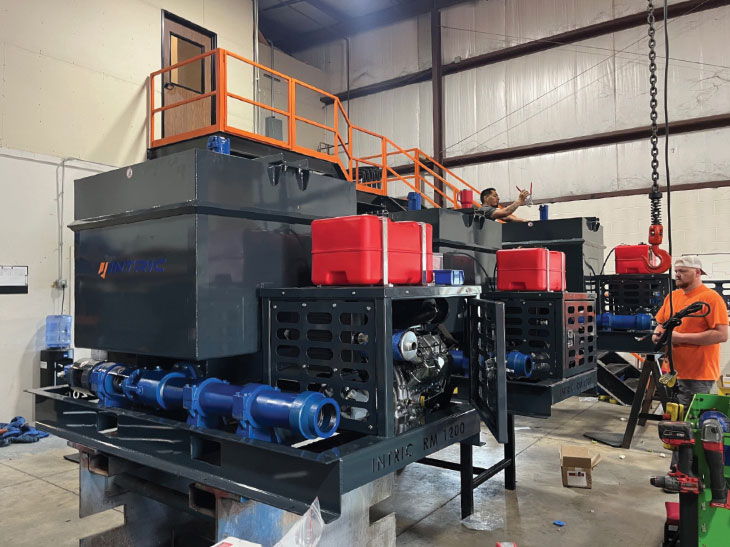
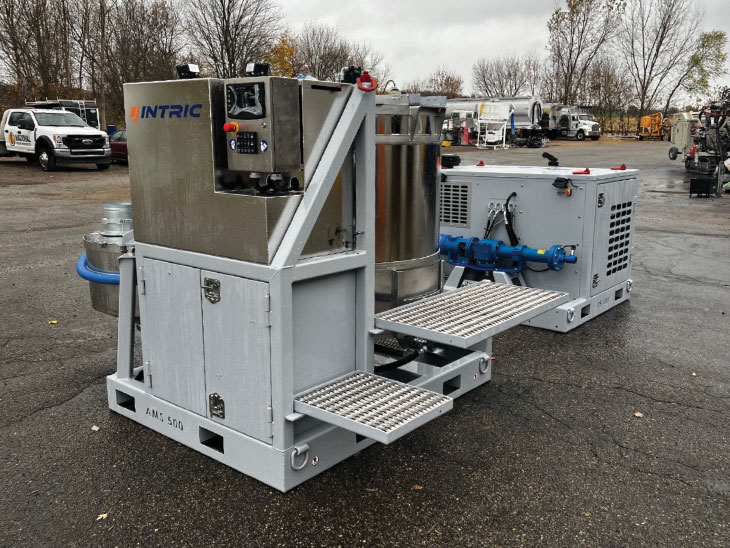
Despite the logistical complexities of remote sites, the transition across the border has been seamless. The main challenge to continued Canadian growth is building awareness of the brand, quality and the support behind it. First-time users often rent a grout plant and quickly find value in its production, performance and reliability, which then converts a rental into a purchase.
Engineering for the pinch points
Roughly 40 per cent of INTRIC’s business is entirely custom. This is where their solution-driven philosophy comes into play. Contractors often approach them not for a standard pump, but to solve a pinch point in their production.
An example is the development of their new custom silos. In the drilling industry, using specialized materials such as type 1L cement or slag often leads to rat-holing, where material sticks to the sides of the silo and won’t dispense. INTRIC quickly went back to the drawing board to design a silo specifically for the drilling market. Some of the key features of the fully self-contained unit include redesigned air pads, tank styles, auger flexibility, clean outs and intuitive batch programming.
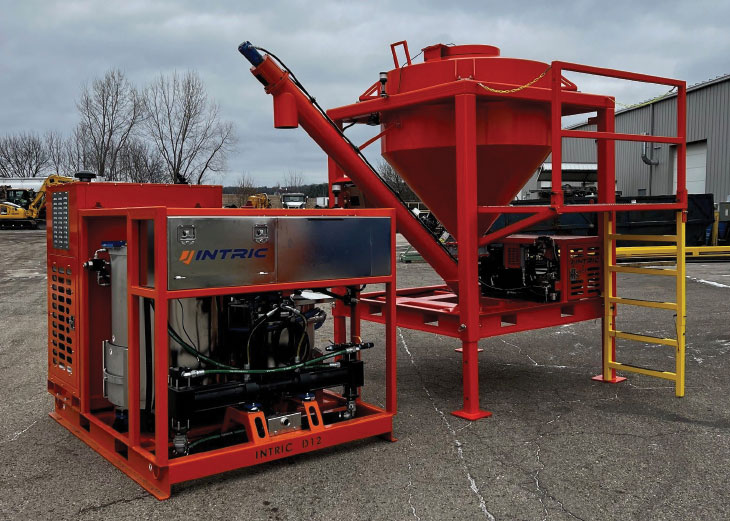
For Canadian contractors, the environment is often as challenging as the engineering. Adapting equipment for the North requires a specific focus on cold-weather resilience and the ability to operate kilometres away from the nearest service hub.
With INTRIC being based in Michigan, a seamless winterization process has always been a key focus of design. Beyond the temperature, the sheer geography of Canadian jobsites demands high-level pump performance. INTRIC’s engineering focuses on an aggressive power curve that allows a single central plant to service an entire site. “The performance of these mixers and pumps allow the flexibility to pump long distances and avoid the need to relocate the plant across a jobsite. The pumps have proven their ability to pump or recirculate grout across multiple city blocks,” said Armata.
For the most inaccessible sites, the equipment is designed to take to the skies. Vander Weide says their D9 can also be split for heliportable jobs.
A hands-on approach to training and support
Because the equipment is often customized or used in complex remote projects, INTRIC maintains a flexible approach to commissioning and troubleshooting. “We are available to meet the commissioning needs of each customer on an individual basis. Whether that is the initial set-up, extended training or even retraining, we have flexibility for on-site training or even a deep-dive education session at our facility in Michigan,” Armata said.
Their commitment to training extends beyond just the jobsite. “We’ve also been part of customers’ normal training programs where they’ll have different drill rig manufacturers and different grout manufacturers all on site for a week at a time,” Vander Weide said. “I think our staff is unique, outside of the machinists and the welders, the rest of us are past drillers and grouters. We get it better than most manufacturers. We know what the customer is experiencing.”
This field experience informs every design tweak. The production team regularly visits jobsites to see their equipment in action. If an operator mentions that a valve is awkward to reach or a screen is hard to read in direct sunlight, those notes make it back to the shop floor.
Reliability in remote operations
For the Canadian industry, reliability is tied to parts and lead times. While INTRIC leverages its Canadian distributors, the Michigan headquarters serves as a rapid-response hub. “Being locally built and sourced is a pretty big deal,” Vander Weide said.
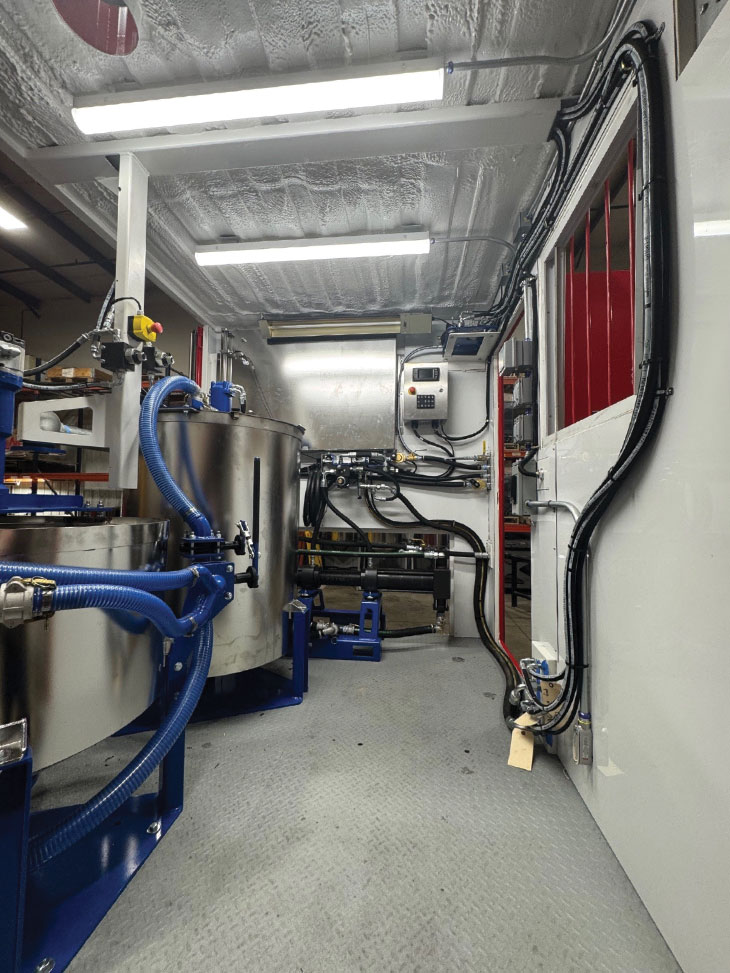
This proximity allows for significantly shorter lead times than overseas competitors. For instance, while some manufacturers have lead times of six months, INTRIC’s newer lines, such as its geothermal machines, currently have lead times of roughly six weeks. When it comes to parts, the customer-first attitude means shipping from Michigan to Canada is a priority, and that ensures downtime is minimized, regardless of the border.
Looking ahead: Geothermal and data
The company is currently seeing a massive uptick in the geothermal market. Since launching their geothermal-specific machines, they have seen rapid adoption, primarily driven by Canadian contractors who encouraged INTRIC to enter the space. These machines offer better mixing ability for smooth grouts and higher pump pressures than traditional geothermal loop installers. Looking ahead, INTRIC is focusing on two main areas:
- Accessibility: Developing entry-level, strictly hydraulic machines for markets that require less electronic sophistication but still demand high durability.
- Sophistication: Integrating advanced data collection.
“We’re going to be putting a lot of effort into more data collection for the more sophisticated jobsites,” Vander Weide said.
The bottom line for contractors
If there is one message INTRIC wants to send to the Canadian piling industry, it is a rethink of the value proposition. “I think contractors focus on the drills and the drill foreman a lot, and they need to, but the grout is the final product and tends to be driven by the lowest guy on the totem pole,” Vander Weide said. “I think they need to invest more into their man and their equipment so that they can provide a better-quality product in the end.”
Armata agrees, noting that eliminating downtime quickly offsets the upfront cost of a premium plant. “When something costs a little bit more than the next piece of machinery, it literally takes one or two days of being down, and the difference is paid for. It almost doesn’t make sense to have a less performing machine. In this business, downtime is the ultimate predator,” he said.
With a footprint that continues to grow from the West Coast to the Maritimes, INTRIC is proving that for the Canadian deep foundations industry, the best solutions are being built right in the neighbourhood. Looking toward the future of the Canadian workforce, Armata hopes to bring that hands-on experience to the next generation of drillers at Fleming College in Ontario.
“It would be really fun … to talk to those guys and go up there and bring it up and stay up there for a week and let everybody have fun with it.”