


Some people choose piling. Others are born into it.
While Brandi Bittner is a Journeyman Red Seal welder with 20 years of experience in the trade, her career is rooted in something deeper. She is part of a four-generation legacy in the piling industry – a lineage shaped by grit, innovation and an instinctive understanding of how foundations are built.
Laying the foundations
Bittner’s grandfather, Horst Steigerwald, completed his first foundation piling job in 1959 for Western Foundation Boring at Northlands Park in Edmonton, Alta. The job contained friction piles and belled piles at a time when the bells were dug by hand. In the years since, Steigerwald has helped to shape the skylines of cities across North America, including Seattle’s George Washington Memorial Bridge in 1962 and Western Canada’s first high-rise at Winnipeg’s Portage and Main in 1966.
“My grandfather founded Double Star Drilling in 1986 and built a reputation for doing what they
said couldn’t be done,” said Bittner. “He worked on West Edmonton Mall, the University of Alberta and the Edmonton Journal Building, as well as the CN Tower in Toronto, just to name a few of his most notable projects.”
“My grandfather warned me that because I was a girl, I was going to have to work twice as hard and, because I was his granddaughter, I couldn’t just be as good as the other welders – I was going to have to be even better.”
Brandi Bittner, HS Tools
In 2002, Steigerwald underwent open-heart surgery and sold his ownership stake in Double Star Drilling to his partner, before returning to the company two years later as a site superintendent. He remained in this position until 2019 and took some time off during the COVID-19 pandemic before returning to work at Marathon Underground. Now 87, he continues to work every day on the jobsite.
“From hole barricades to chin-strapped hard hats to the way people are now being trained, a lot has changed in the years my grandfather first started out,” said Bittner. “He says that smartphones on site drive him crazy, and he is always catching guys who are staring at their phones. Back in the day, when you didn’t move fast enough, you got yelled at. At least I know I did.”
Bernie LeRoux, Bittner’s father, sadly passed away in September 2025, at the age of 70. He set foot on his first construction site at the age of 14 with Western Caissons Limited, doing a hospital addition in Winnipeg, Man. LeRoux was involved with Double Star Drilling for years until the early 2000s, when he started with Pacer Construction. He quickly became the company’s senior superintendent and spent the next decade helping to shape the Alberta Oil Sands.
Continuing the legacy
Bittner grew up standing on the front seat of her grandfather’s truck, watching the operators work and counting how many holes each crew drilled and poured that day. As she got older, Bittner delivered parts and tools all over Western Canada. On occasion, she would drive truck-mounted rigs to sites for drillers who didn’t have their Class 3 license and helped when needed. Her first “real” job in the trades was welding light standards in a production plant in Acheson, Alta., at the age of 21, not 100 per cent sure where it would take her.
“My grandfather asked me for help welding a tool, and we built a twister for a 60-inch casing that was sent to the site at the bus bridge crossing Fox Drive in Edmonton, Alta.,” said Bittner. “The Double Star Drilling owner told me that if I ever wanted a job, I could come back anytime. A couple of months later, I drove down Fox Drive and saw the bridge, and I remember thinking how cool it was that something I built helped do that. From that point on, I was hooked.”
Bittner started at Double Star Drilling two weeks later without telling her grandfather, and when he found out, he wasn’t entirely happy.
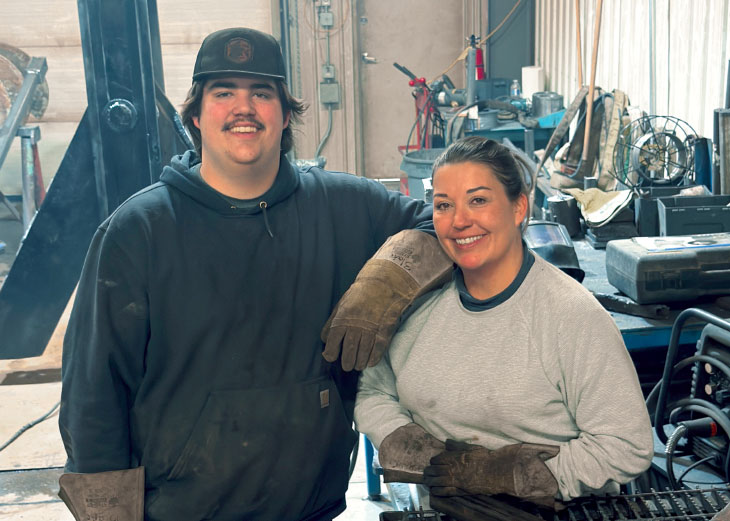
“My grandfather warned me that because I was a girl, I was going to have to work twice as hard and, because I was his granddaughter, I couldn’t just be as good as the other welders – I was going to have to be even better,” said Bittner. “That was 23 years ago, and I would be lying if I said it was easy. My grandfather was right about a few of those things, and there were a few journeymen who made sure I knew that they didn’t think I belonged there, and being a female in the industry back then was definitely very different than it is today.”
Despite having a family stake in Double Star Drilling, Bittner’s path was not easier at the beginning.
“My grandfather and father always made it clear to me and to everyone else that I was going to have to earn my place in this industry,” said Bittner. “Even my brother, who was my superintendent, told me that [if] he had to come and help me, then what did he have me for? So, I had to learn how to do things on my own, and I spent the better part of 18 years learning how to repair, build, modify and design anything and everything Double Star Drilling needed, and that five degrees and one-eighth of an inch can make or break any tool.”
In 2021, Bittner made the difficult decision to leave Double Star Drilling and offered her experience in building, repairing and designing deep foundation drilling tools for any piling and drilling company that needed it.
“I got my opportunity to try the piling industry because of the previous generations of men in my family that started before me, and I stayed in it because I fell in love with the industry,” said Bittner. “I guess it’s in my DNA, and when my grandfather and my dad talked business, I listened. So, in 2015, I created HS Tools – HS being my grandfather’s initials. I wouldn’t be where I am if it wasn’t for him and it seemed like the least I could do to show my gratitude.”
A future in drilling
Bittner’s son, Blake, recently started the Registered Apprentice Program for heavy-duty equipment technicians at Double Star Drilling, after wanting to be a heavy-duty mechanic since he was three years old. He also spends time working with Bittner in the welding shop whenever possible.
She is both excited and nervous to watch him make his mark at a company that has played such a large part in her family’s history for four generations. The best advice she can offer to him – and anyone thinking about entering the construction industry – would be “to find the part that speaks to you and then don’t let anything stand in the way of learning everything you can about it.
“Ask questions and listen to the generations before you. They have seen and done things before modern machines and tools have made the job easier. Their experience can teach you things you can’t learn on your own or read in a book. Don’t try and re-invent the wheel and look to make everything one per cent faster, lighter and stronger. You can then let the work speak for itself,” she said.