

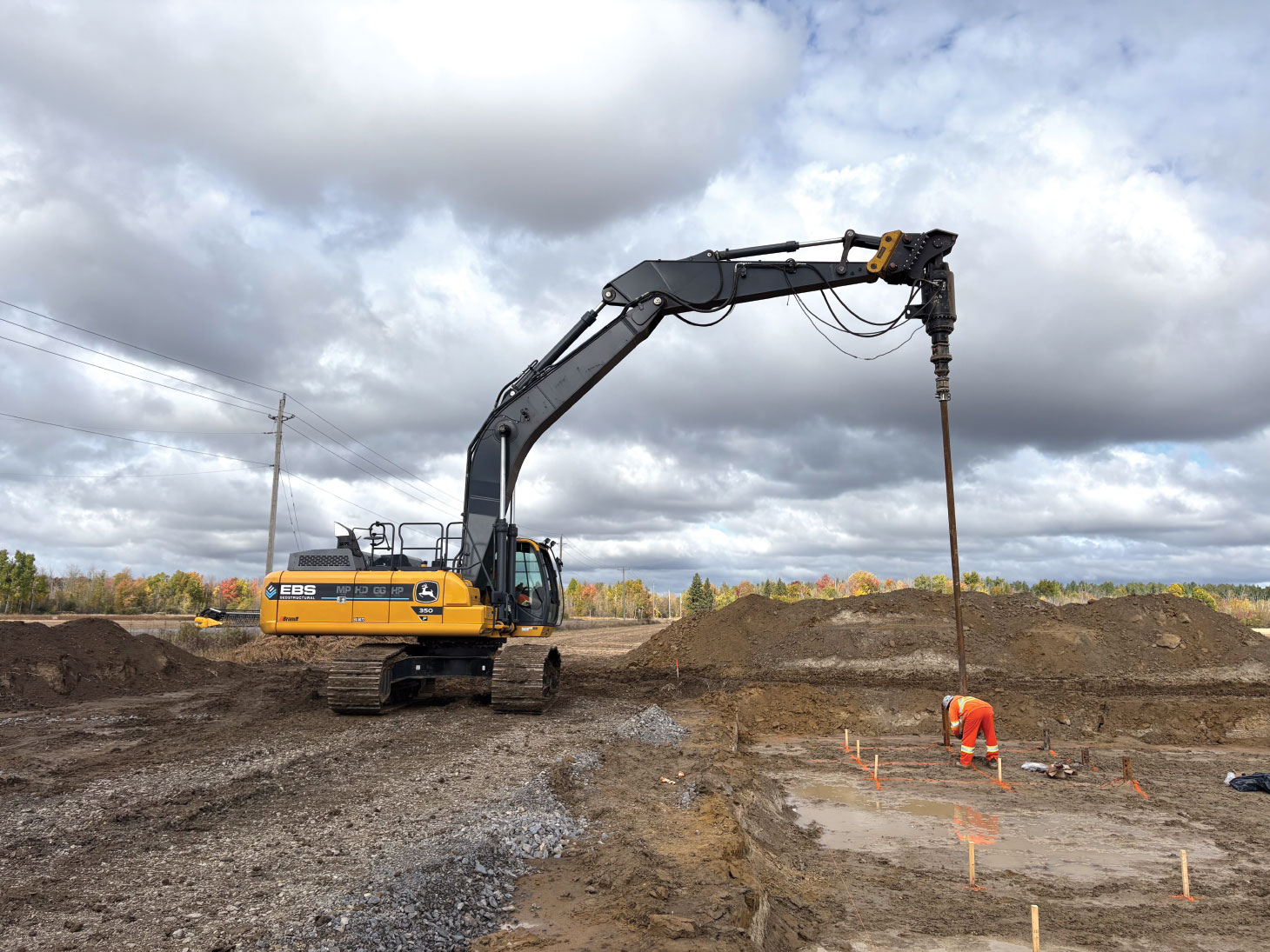
A leader in specialty deep foundations, EBS Geostructural prides itself on resolving complex constructability problems. A recent example is how the company based in Breslau, Ont., came up with an effective foundation solution for a cellular communications tower being built in far from ideal ground conditions.
EBS Geostructural, which offers helical pile, micropile, Olivier pile and geotechnical shoring solutions for the commercial, industrial, institutional and residential construction sectors, was given this task during the early stages of the project in May 2025 by WesTower Communications, the wireless network contractor installing the 80-metre-tall tower for Bell Canada’s cellular network.
Braxton Collins-Robb, a project manager at EBS Geostructural, says in instances like this, his company’s team of structural engineers excel at identifying alternate methods when traditional deep foundation methods may not work. He says the main problem facing the cell tower foundation designers was very soft soils combined with fairly deep bedrock underlying the construction site, which is situated in a farmer’s field outside the town of Kemptville, Ont.
In the geotechnical report EBS Geostructural received from WesTower Communications, “we saw there were geotechnical N-values of zero to five blow counts from the surface to 55 feet deep, so very soft soils, mostly clay. Bedrock was also found at 58 feet below surface, so relatively deep,” said Collins-Robb. “This posed a bit of a challenge for the foundation design, as they couldn’t really go with their standard foundation method for this.”
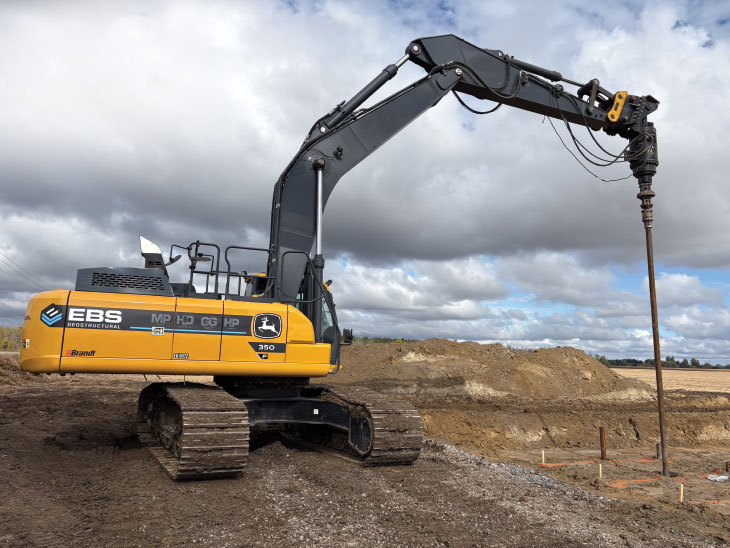
The solution devised by EBS Geostructural was a helical pile and concrete pile cap design tailored to the site’s soil conditions and high load requirements that ensured the structural stability and safety of the tower. According to Collins-Robb, the concrete pile cap at the tower’s base was designed to distribute the structure’s tension and shear loads, which allowed the helical piles to be installed down to the bedrock level to support the compression loads.
“Basically, this eliminated the need to install a driven pile or micropile down into bedrock. This made helical piles a more cost-effective option in this case,” he said. He adds rather than opting for a typical helical pile installation, EBS Geostructural decided to go with helical piles with relatively large helixes that increased their effectiveness in supporting the tower structure.
The EBS Geostructural team spent a couple of weeks developing the helical pile/concrete pile cap solution, which was then sent on to WesTower Communications with a preliminary foundation design and pricing estimate.
After that, WesTower Communications sent the project out to tender and Korol Contracting, a telecommunications contractor based in Ancaster, Ont., specializing in cell tower construction and maintenance, was awarded the role of general contractor in July 2025. Korol Contracting then subcontracted EBS Geostructural to do the final design for the helical pile/concrete pile cap foundation and to install the helical piles for the tower once the design was approved.
“The preliminary design that EBS Geostructural worked on with WesTower was discussed with Korol Contracting and then EBS Geostructural was able to turn around our drawings pretty quickly,” said Collins-Robb. “We submitted the foundation design drawings to Korol Contracting for their review and approval with WesTower prior to our mobilization.”
Quick turnaround
After the piling materials had been ordered and delivered to the construction site, a foundation installation team from EBS Geostructural arrived on Oct. 7, 2025. Collins-Robb says it only took a few days to finish the job. “Our scope of the project was completed on time and on budget. EBS mobilized, installed 36 piles, drilled, cut, capped and demobilized from the site within four days, so it was a very quick turnaround,” he said.
Collins-Robb notes each of the three dozen helical piles came with an ultimate compression load rating of 556 kilonewtons, adding the concrete pile cap formed a platform 0.75 metres thick and just under 16 square metres in size. Roterra Piling, a piling supplier based in Acheson, Alta., just outside Edmonton, Alta., supplied the helical piles for the project and EBS Geostructural used its John Deere 350 excavator to install the piles.
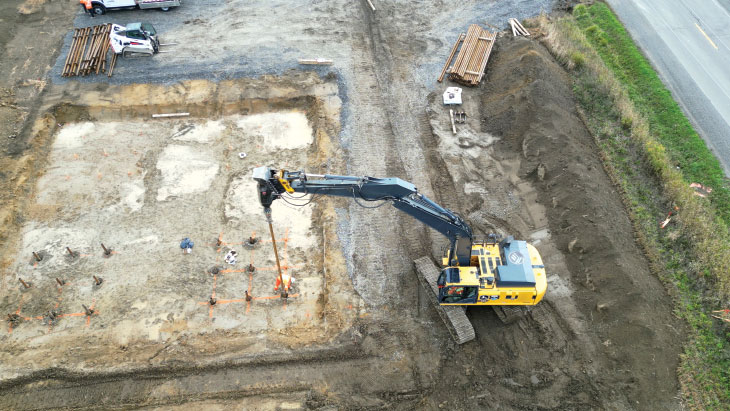
“Because of the required depth of the piles, we ordered all of our material in 20-foot lengths. We were able to use the John Deere 350 to efficiently install the 20-foot sections,” said Collins-Robb. “Our best installation day on that site was 1,232 feet of helical pile length. We were able to get pretty high production numbers, especially with the longer sections of pile.”
Collins-Robb says the cell tower project demonstrated the value of early involvement from a geostructural specialist like EBS and it also illustrated how helical piles can have a wide range of installation capabilities.
He says the project also showed how helical piles, when used in combination with concrete pile caps, can achieve “very high compression, tension and lateral loads in soil conditions that are very, very soft, in this case zero to five blow clay. It allows us to ensure a project like this is feasible. “I think helical piles are generally perceived as a pile that can’t get very high capacities, but it’s amazing what capacities they can get, even in soil conditions like this that are generally seen as subpar.”
Collins-Robb notes he has run into similar situations where a helical pile/concrete pile cap combination was used by foundation designers. “I recently priced three tower projects in Oshawa that utilize the same tower foundation design,” he said.