

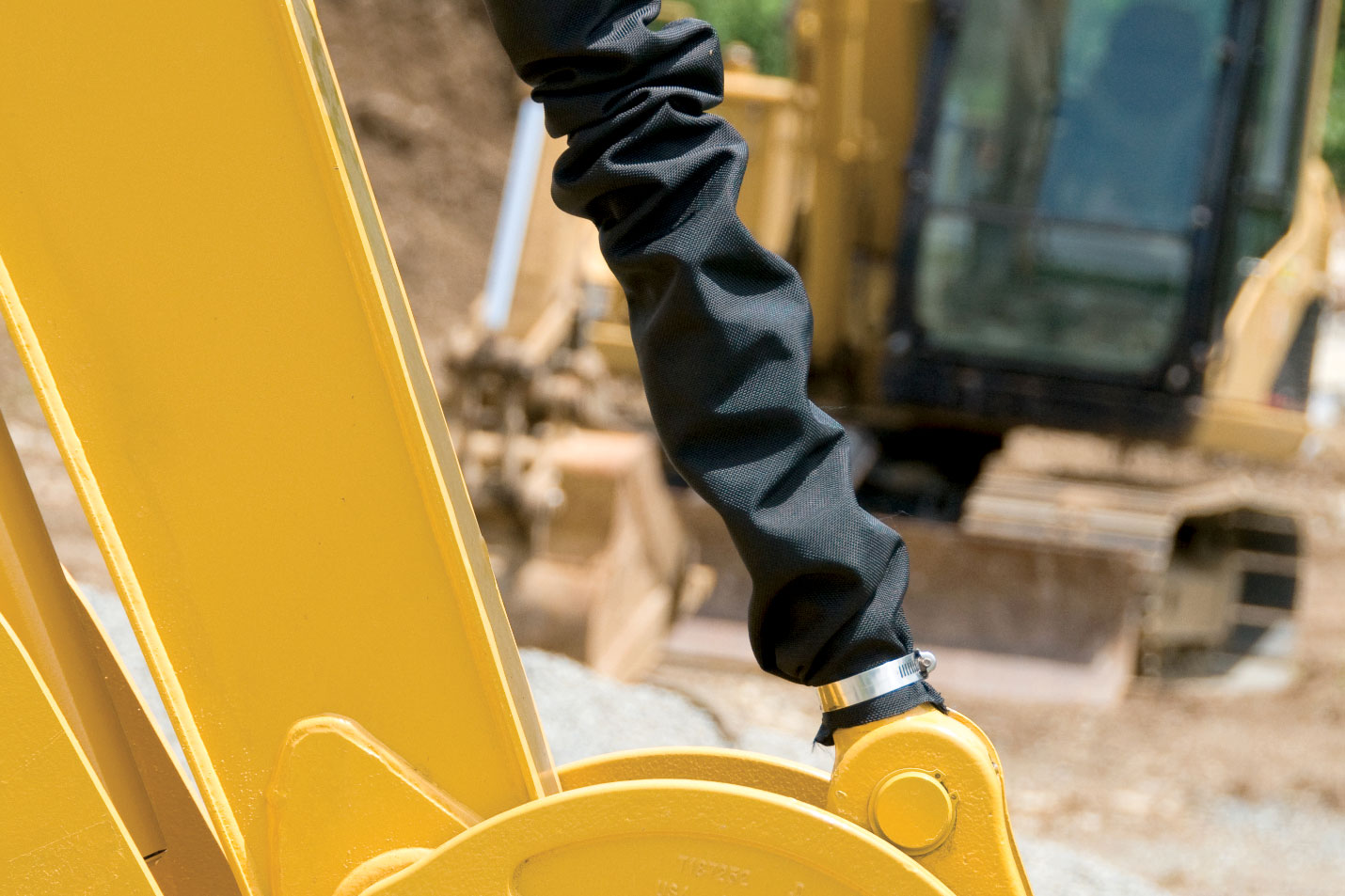
In the deep foundation world, performance failures rarely begin with the headline components. They often start with the systems that power everything else, such as hydraulic hoses, electrical cables and bundled lines running along vibrating, mud-covered machines operating in some of the world’s harshest environments.
That reality has put a growing spotlight on a category of products that rarely gets much attention but have become increasingly important in determining whether equipment stays productive or ends up sidelined. For nearly 60 years, Techflex has focused on that problem and has developed engineering-braided sleeving and cable protection systems designed to shield wires, hoses and cables from abrasion, heat, chemicals and mechanical damage.
Techflex has grown into a global manufacturer supplying protective sleeving across construction, infrastructure, manufacturing, aerospace, rail, HVAC and heavy equipment sectors. For the piling and deep foundation industry, the company’s products have become a critical layer of preventive maintenance for keeping rigs running, protecting operators and reducing downtime.
“We’re really a pretty niche company,” said Driscoll Bowlby, technical sales account manager at Techflex. “We offer a wide range of products for multiple industries.”
That niche has become increasingly important as foundation equipment grows larger, more powerful and more technologically complex. Piling rigs, drills and support machines rely on hydraulic hoses and electrical lines that are often routed through tight spaces that experience vibration, movement and abrasion.
“At the end of the day, it’s preventive maintenance. It’s about keeping the machines running.”
Driscoll Bowlby, Techflex
“In this industry what we see mostly is hose protection,” Bowlby said. “That’s the big focus since pile driving rigs and drills use numerous hydraulic hoses.” For deep foundation contractors, Techflex’s most common solutions are wrappable sleeving products that can be installed over existing hoses without disconnecting them. “That’s really the name of the game in this industry,” Bowlby said. “We offer the protection companies require with convenient installation.”
Unlike traditional enclosed sleeves that must be installed during hose assembly, wrappable products allow crews to retrofit protection in the field. This approach is beneficial on active jobsites, where shutting down a rig to replace hoses can lead to lost time, labour costs and scheduling delays. Protective sleeving can wear out and be replaced without touching the underlying hydraulic system.
“The sleeve is a useful addition, and when it gets worn out, it can be replaced in a timely manner without much downtime,” explained Bowlby.
Although abrasion from soil, rock and debris is a major concern, Bowlby says that vibration is often the hidden culprit behind premature hose failures. Without proper containment, hoses can migrate, rub against steel edges or catch on moving components. Wrappable sleeving not only shields hoses from external damage, but also bundles them together, reducing uncontrolled movement. Much of the demand for hose protection doesn’t start in the engineering office. It begins in the cab.
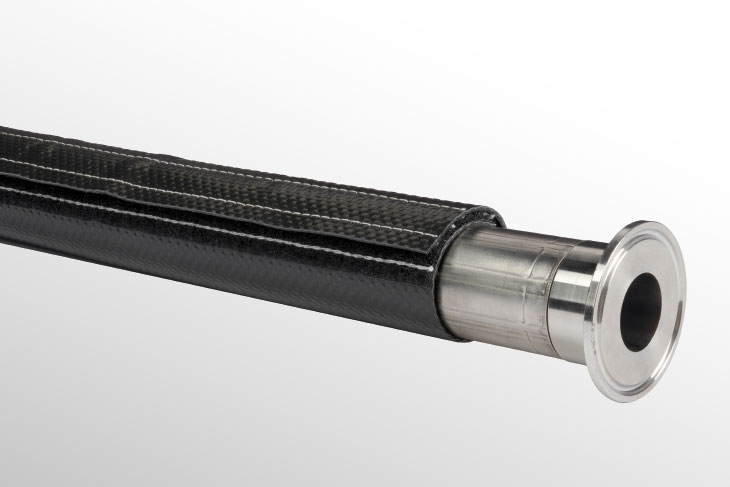
“A lot of the requests come from the operators and mechanics,” Bowlby said. “Their knowledge and experience dealing with the everyday abuse and repairs needed to keep the machines operable offers great insight.”
While maintenance, repair and operations teams play a role, operators are often the first to notice recurring wear points, ruptures or near-miss safety incidents. Their feedback drives adoption as part of a broader preventive maintenance strategy.
Beyond downtime and repair costs, hose protection is increasingly viewed through a safety lens. High-pressure hydraulic failures can pose serious risks to personnel. Techflex products, such as the Dura Flex Burst Shield, address this issue through a double-lined heavy-duty sleeve. The company’s product line also includes both enclosed and wrappable sleeves with materials engineered for varying levels of abrasion resistance, flexibility and environmental exposure.
Customization has become increasingly common. Bowlby estimates that the company sees it on 30 to 40 per cent of its projects. Customization is usually about fit since every rig has a unique hose layout, routing geometry and operating envelope. “Every machine is completely different, so it really goes to the application of each machine and protection requirements,” he said.
Equipment is becoming more powerful and increasingly compact with greater power concentrated into smaller spaces, so a higher level of protection is required.
Depending on the machine layout and operating conditions, Techflex frequently adds straps or buckles to prevent sleeves from migrating during operation, it incorporates pass-throughs to accommodate complex hose junctions and supplies custom-cut lengths with flared or tapered ends to match specific routing requirements. Fastening systems can also be modified with Velcro or buckles instead of traditional ties to improve accessibility and provide long‑term reliability.
Techflex often works as a technical partner and uses a detailed question-and-answer process with dealers, OEMs and contractors to create solutions. Once the required products are identified, Techflex often sends samples for test fitting before finalizing a solution. The company also works with a wide range of industries and that experience frequently goes back into construction applications.
“We always say our products go anywhere from aerospace to welding and everything in between,” Bowlby said.
Solutions developed for one sector often find new applications elsewhere. A thin, breathable wrap originally designed for HVAC line insulation protection, for example, is now used by some customers for basic cable management because of its UV resistance and durability. Another trend that has been developing in recent year is the need for new products that can withstand higher temperatures. Equipment is becoming more powerful and increasingly compact with greater power concentrated into smaller spaces, so a higher level of protection is required.
Techflex employs approximately 160 people, with manufacturing and operations spread across multiple U.S. locations, including facilities in New Jersey, Georgia and Texas. Canadian business is largely handled through distribution and a regional representative agency, with products flowing into sectors such as rail, infrastructure and heavy equipment.
Although Techflex’s products might not draw that much attention on a jobsite, their success is measured in hoses that don’t rupture, cables that don’t chafe and machines that don’t go down unexpectedly. “At the end of the day, it’s preventive maintenance,” Bowlby said. “It’s about keeping the machines running.”