

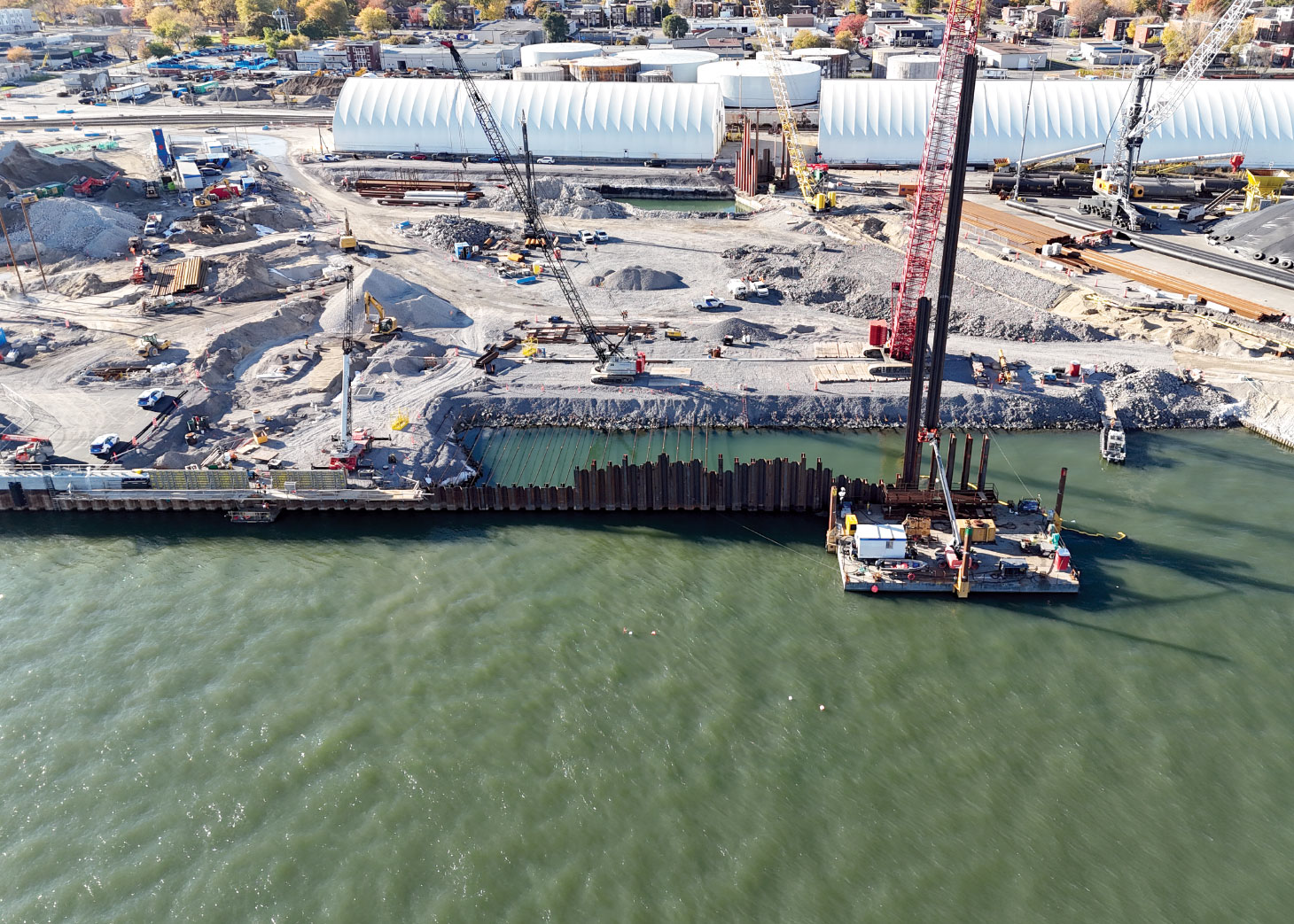
Modernizing a working marine port is never a simple undertaking. When that port is located on one of Canada’s most critical corridors along the Saint Lawrence River, the technical, logistical and scheduling demands can be challenging.
That reality is playing out at the Port of Trois-Rivières, where piers 16 and 17 are being rebuilt and expanded as part of a $312-million infrastructure program designed to strengthen Quebec’s marine, agri-food and aluminum supply chains.
At the heart of this project is a large-scale, high modulus combi wall foundation system designed to provide the strength and durability required for deep-water port operations. As the exclusive North American partner of ArcelorMittal, JD Fields Canada ULC served as the conduit co-ordinating and supplying the specified HZ-M engineered wall system.
The piers 16 and 17 project is part of a broader modernization effort at the Port of Trois-Rivières, supported by the Governments of Quebec and Canada, the Trois-Rivières Port Authority and private-sector partners, including G3 Canada and Alcoa. The new piers will accommodate deeper-draft vessels, increase intermodal efficiency and support long-term growth in bulk commodities and aluminum exports.
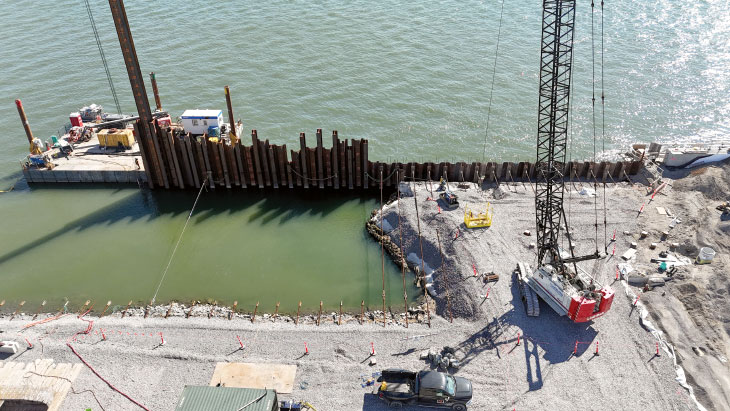
The project required a very stiff and deep marine wall system capable of resisting heavy loads while performing in a corrosive, tidal environment. CIMA+ provided the engineering analysis and design while Pomerleau, a Québec-based contractor performed the work.
“Two phases of the project required HZ-M pile lengths of 100 feet (ft.) and 139 ft. These are specialized deep foundation pile profiles that are only produced by ArcelorMittal in Luxembourg,” Fred Burelle, business development manager with JD Fields Canada, said.
Just as important as the HZ-M structural shape, is the mechanical connection between the beams and the intermediate sheet piles. Other king pile, copycat beam offerings piece their systems together, relying on full-length welds for structural connection and those welds tend to be more susceptible to corrosion in marine environments.
The manufacturing process for piers 16 and 17 combi wall system included multiple European facilities that had to be carefully co-ordinated to meet both length and performance requirements. Burelle says they rolled the material in Luxembourg, using the Differdange plant for the HZ-M beams and the Belval plant for the AZ sheet piles. For the longest elements (those exceeding the rolling capacity of the mills) additional fabrication was required.
The HZ-M system offered both structural and durability advantages in a marine environment because there is a lot more surface exposed to marine water with a pipe section
“For the part of the wharf that was above the maximum rolling capacity, we shipped those pieces to a fabrication shop in the region to make the splice,” he said.
Once assembled, the piles were transported to the Port of Antwerp, where they were staged for overseas shipment. Transporting steel elements approaching 140 ft. in length presented some obvious challenges. For JD Fields Canada and its project partners, avoiding road and rail movement was a key part of their execution strategy.
“We delivered directly by barge vessel,” Burelle explained. “The material never touched rail or road, which would have been very expensive for these lengths.” Once the steel arrived in Quebec, staging and delivery were handled entirely within the port facility. “Logistec was our stevedoring (loading and unloaded cargo) company,” Burelle said. “They unloaded the vessel and stored the material on their site, the closest possible to the jobsite.”
From there, delivery to the installation area was straightforward. It was only 100 yards of transloading to complete. Minimizing this distance helped reduce congestion, minimizing handling damage and avoiding scheduling conflicts with ongoing port operations. The selection of an HZ-M combi wall system, rather than a pipe-Z or fabricated alternative, was driven by a combination of depth, soil conditions and long-term performance considerations.
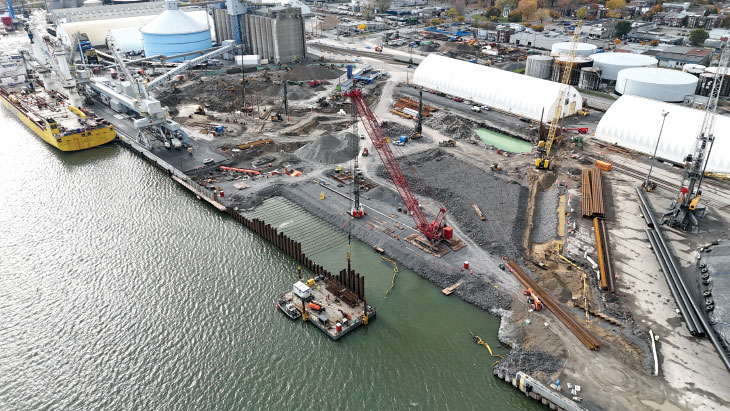
“They needed a deep-water wharf, but the port draft had to be less, so they needed a very stiff wall,” Burelle said. “The soil conditions were right to use an HZ-M wall.”
Compared with pipe-based combi-walls, Burelle says the HZ-M system offered both structural and durability advantages in a marine environment because there is a lot more surface exposed to marine water with a pipe section. Only the front face is exposed to the water with the HZ-M beam, and the web and back flange are confined in soil. That reduced exposure translates into lower corrosion risk and longer design life.
The piers 16 and 17 project unfolded in multiple phases, with JD Fields Canada supplying materials to both the Trois-Rivières Port Authority and the contractor. The port authority initially bought some of the materials directly to ensure they had material to start the job. JD Fields Canada received the first order in early 2024, with initial deliveries completed by summer. Subsequent phases were supplied under contract with Pomerleau, with additional deliveries in fall 2024 and winter 2025.
Asked whether the project revealed any lessons that would change JD Fields Canada’s approach on future marine works, Burelle was clear. “If I had to do it again, I would do it the exact same way,” he said.