

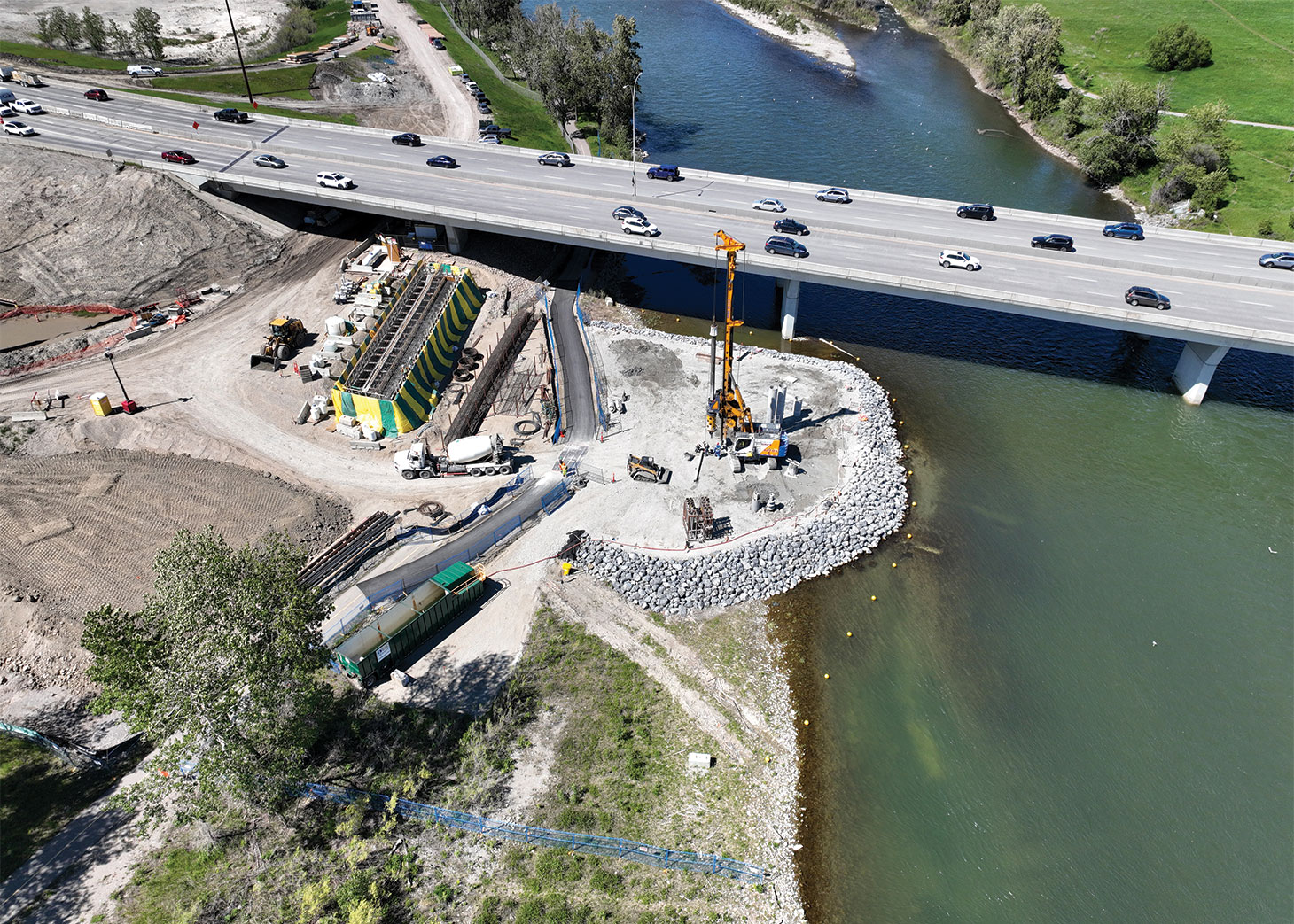
Deerfoot Trail is a provincial highway and major north–south transportation corridor bisecting Calgary. With the city’s population doubling since the 1970s, Deerfoot Trail is now the most heavily travelled road in Alberta, with more than 180,000 vehicles traversing it each day.
In 2023, work began on an ambitious plan to upgrade Deerfoot Trail with a slew of much-needed improvements that will increase its capacity to handle current and projected traffic volumes well into the future. The Deerfoot Trail Improvements initiative is divided into several projects, with work focused in congested areas where upgrades can be completed quickly to eliminate existing bottlenecks and improve the safety of the highway overall. This includes increasing capacity by adding lanes, increasing ramp capacities, reconfiguring exits and interchanges, and twinning the Ivor Strong Bridge.
Improvements to Deerfoot Trail were informed by a joint study by the City of Calgary and the Alberta Government. The Alberta Government is funding the $595 million project, which is slated for completion in 2027. Once construction ends, motorists using the improved Deerfoot Trail can expect to spend less time stuck in traffic, and goods will move more safely and efficiently.
According to an Alberta Government news release, after the improvements are completed, “drivers can expect their commutes to be 15 per cent faster during morning rush hour and about 22 per cent faster during evening rush hour. Taken together, these upgrades will save approximately 900,000 hours a year for Calgarians.”
Complex undertaking
Shane Hemenway is the construction manager for the owners’ engineer, Associated Engineering Alberta Ltd. Associated Engineering is a Canadian engineering firm well-versed in delivering complex transportation projects across the country, ranging from pedestrian trails and cycle paths to airports, intermodal facilities and urban bypass highways.
Hemenway explained Deerfoot Trail Improvements are comprised of four design-bid-build or traditional delivery contracts, and a larger alternative delivery design-build contract. According to Hemenway, the design-bid-build projects primarily involved lane widening and ramp improvements on different parts of Deerfoot Trail and have now been completed. The alternative delivery design-build project is still underway.
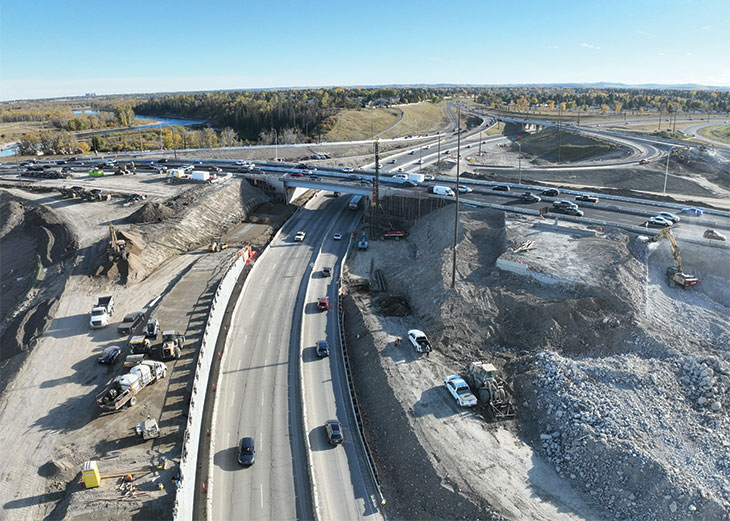
“It’s quite a complex undertaking,” said Hemenway. “The design-build contract includes road widening as well as construction of seven new bridge structures and associated ramp works at the existing interchanges at Glenmore Trail, Southland Drive, Anderson Trail and Bow Bottom Trail and the twinning of the Ivor Strong Bridge over the Bow River. It also includes 39 overhead guide sign structures.”
Aecon Infrastructure Management is the contractor delivering the design-build contract, where project design and construction occur concurrently. This process allows projects to be delivered in less time and provides contractors with more opportunities to innovate to meet the requirements of the contract. Deep foundation work is an important aspect of the Deerfoot Trail Improvements project and is being performed by Aecon Foundations, part of the Aecon Group of companies.
“It’s the busiest highway in Alberta, so traffic accommodation and working around traffic was probably the biggest complexity.”
Shane Hemenway, Associated Engineering Alberta
Hemenway notes piling installations were needed for all the new bridge structures. He says this includes driven steel H-piles ranging 10 to 20 metres long, as well as drilled reinforced concrete piles upwards of 29 meters deep. “There are also a few spread footings on some of the bridges due to shallow bedrock,” Hemenway added. One of the bridges, a five-span flyover structure at one of the interchanges, required all three foundation types, says Hemenway. He adds that secant pile walls were installed in one area to protect a deeply buried utility, and reinforced concrete piles are being used to support the overhead guide sign structures that are part of the design-build project.
According to Hemenway, much of the reinforced concrete piling is going into gravelly soils, and there has been some water present at most of the drilled holes. As a result, casings have been used for most of the foundation holes and additional measures such as cross-hole sonic logging and the use of hydration-stabilizer admixture concrete have also been implemented. Hemenway notes that environmental protection measures were required for the twinning of the Ivor Strong Bridge. In-stream piers were built to facilitate piling installation and construction, which required temporary work terms and regulatory approvals through the Provincial Water Act, the Federal Fisheries Act and the Federal Navigable Waters Protection Act.
Total pile production numbers for the design-build project are as follows:
- Approximately 310 steel H-piles
- Approximately 90 drilled reinforced concrete piles
- Four spread footings
Junttan PM25 pile driving rigs equipped with HHK5/7/9SL 7,000-kilogram hydraulic hammers have been used to install the steel H-piles, while two hydraulic drill rigs, a Bauer BG 28 and a Liebherr LB28-320, are installing the reinforced concrete piles.
Site congestion
For most everyone involved in the Deerfoot Trail Improvements project, the biggest challenge has been how to do all this work so close to an extremely active and crowded roadway. “It’s the busiest highway in Alberta, so traffic accommodation and working around traffic has been the biggest complexity,” Hemenway said, adding safety considerations to protect both construction workers and the travelling public are always top of mind. As Hemenway points out, there have also been plenty of logistical challenges.
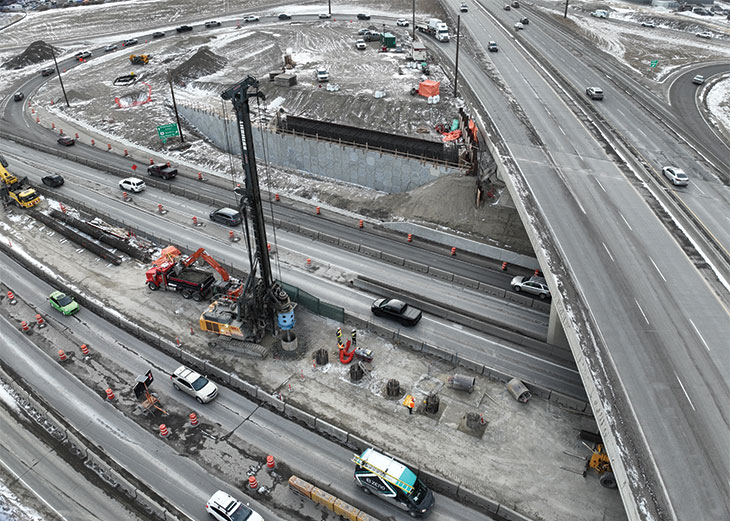
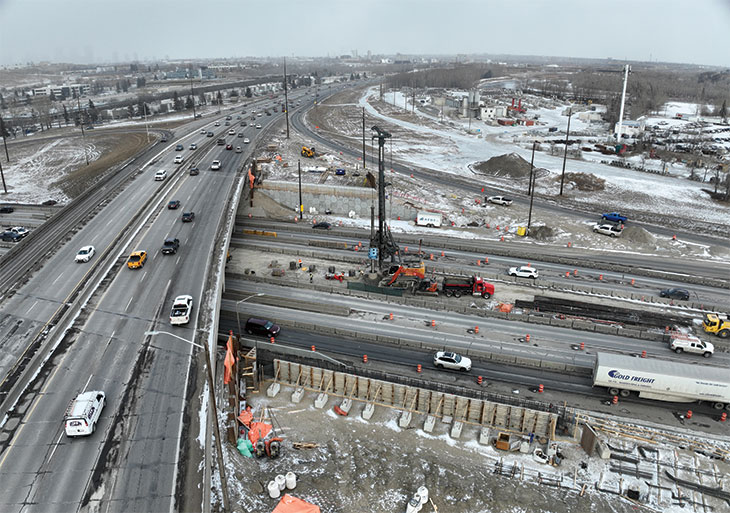
“There was a lot of congestion, traffic detours and access limitations, so a lot of this required the work to be done at night when there was less traffic. That introduced complexities to the contractor’s scheduling and timing,” he said. “The congested sites were, again, considerations for things such as what do you do with your spoil, where do you put your equipment and support vehicles in these very tight areas. That required some additional planning on the contractor’s part.”
Hemenway says the crowded site conditions also added a layer of complexity at some deep foundation locations where piles interacted with mechanically stabilized earth walls. In these cases, he explained, “there were some sequencing considerations” as planners had to determine which element needed to be installed first.