

There is a quiet shift happening in Canada’s push toward net-zero – and it’s happening underground.
As the country accelerates its clean energy build-out, the conversation is no longer just about what gets built. It’s about how. Because every wind turbine, every transmission tower, every energy storage system starts the same way: below the surface. And increasingly, the sector is being asked to do more than deliver performance. It is being asked to deliver responsibly.
Foundations for a renewable nation
Canada’s clean energy ambitions are massive and they are moving quickly. Roughly 79 per cent of the country’s electricity already comes from low-carbon sources. But getting to a net-zero grid by 2035, and a net-zero economy by 2050, will require a level of construction activity that Canada has never seen before.
In 2025 alone, the country added another wave of wind, solar and energy storage capacity, bringing total installed capacity to approximately 25 gigawatts. That number is expected to grow by another 50 to 60 per cent by 2035.
Alberta may have led early procurement, but Quebec is now targeting a tripling of its wind and solar capacity, while British Columbia is planning to quadruple its own, and every one of those projects depends on foundations. For the deep foundation industry this is an opportunity that comes with the pressure to not just build fast, but to build differently.
The green foundation’s best friend
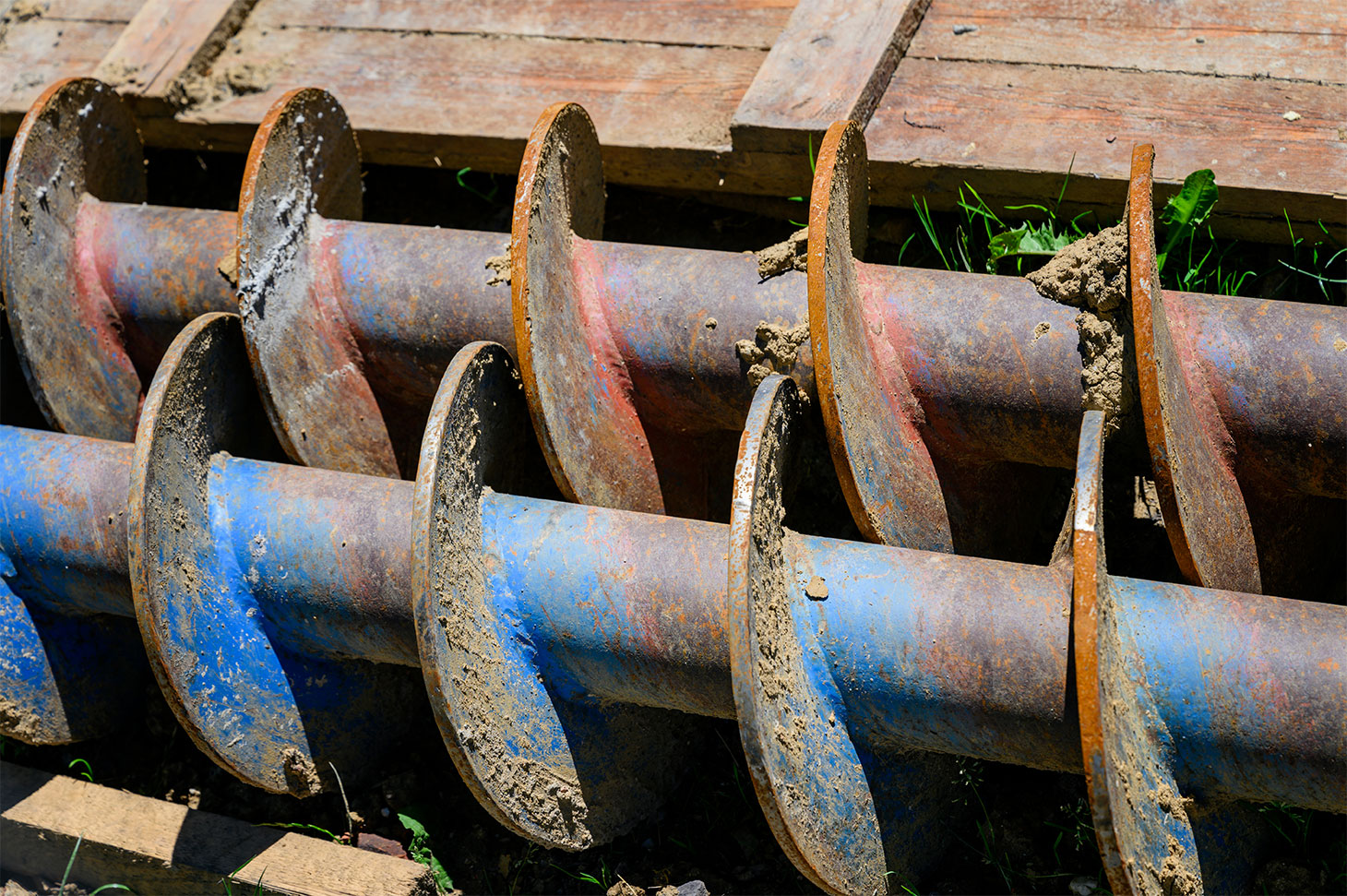
Helical piles are quickly becoming one of the sector’s clearest responses to that pressure. Their advantage is that they go into the ground with less disruption and come out cleaner on the other side. Unlike traditional driven or cast-in-place systems, helical piles are installed by rotation, minimizing soil disturbance. More importantly, they often eliminate the need for concrete altogether.
Cement production accounts for roughly seven percent of global greenhouse gas emissions. Reducing reliance on concrete isn’t a marginal gain, it’s a meaningful shift in how projects carry their carbon footprint from the start. There’s also a life cycle advantage. Helical piles can be removed and reused, which fundamentally changes how we think about temporary and long-term infrastructure.
On battery energy storage projects, like Ontario’s Oneida facility, those benefits become practical, not just environmental. Crews can install 20 to 30 piles per day without waiting for curing. And the systems adapt well to Canada’s varied soil conditions.
Decarbonizing the equipment fleet
The equipment used to install those foundations has his torically been one of the biggest sources of emissions on a jobsite. That’s starting to change. Junttan has introduced the PMx2e, the first fully battery-powered electric pile driving rig. Equipped with two detachable battery packs, the machine can operate for up to 13 hours without diesel.
The companies that will lead over the next decade are not just the ones who can build efficiently. They are the ones who can build with awareness of materials, of emissions, of long-term impact.
The benefits include lower emissions, reduced noise and improved energy efficiency. In practice, operators are also reporting better responsiveness, thanks to instant torque from the electric drivetrain. Junttan estimates the rig can reduce CO₂ emissions by up to 47,000 kilograms per year compared to its diesel equivalent, a 95 percent reduction over its life cycle when powered by renewable electricity.
In a country where most of the grid is already low carbon, electrification is not a future concept. It is a present-day decision. And it is forcing contractors to rethink what standard equipment looks like on Canadian jobsites.
The embodied carbon imperative
Even where concrete remains unavoidable, the conversation is shifting. The federal government has committed to reducing the embodied carbon of structural materials in major projects by 30 per cent starting in 2025. Environmental product declarations are now required for concrete on projects over $5 million, and procurement policies are beginning to favour lower-carbon alternatives. For the deep foundation sector, that changes the rules.
Large-diameter shafts and concrete-filled piles are still essential for heavy infrastructure. But how that concrete is specified and what goes into it is now under scrutiny. Supplementary cementitious materials, optimized mix designs and performance-based specifications are no longer niche considerations. They are becoming part of the baseline expectation.
The shift is subtle, but significant. It moves the industry away from “this is how we’ve always done it” toward “this is what performance allows.”
Permafrost: where climate meets engineering
In northern Canada, the stakes are even higher. For decades, permafrost has served as a stable bearing medium for foundations across Yukon, the Northwest Territories, Nunavut and northern Quebec. As temperatures rise, permafrost is thawing faster than many designs anticipated. Research published in 2024 highlights a critical gap: there is still no national design code specifically addressing foundations in permafrost conditions.
Engineers are being forced to rely on experience, judgment and increasingly complex modelling to manage thermal effects and long-term performance. Buildings, roads and utility corridors are at risk as the ground shifts beneath them.
In response, the industry is developing more rigorous thermal models, integrating thermosyphons and insulation systems, and pushing for the national standards that would bring consistency to these designs. This is an active challenge that is reshaping how foundations are designed in some of the country’s most vulnerable regions.
The industry’s moment
Taken together, these shifts point to something bigger than incremental change. The deep foundation industry is being pulled into a new role where technical performance is no longer enough on its own. Clients are asking different questions. Governments are setting new expectations. And the projects, whether in renewable energy or northern infrastructure, are exposing the limits of old approaches.
The companies that will lead over the next decade are not just the ones who can build efficiently. They are the ones who can build with awareness of materials, of emissions, of long-term impact. Because what happens below the surface is no longer invisible. And the decisions made there are starting to define what sustainable construction actually looks like.