

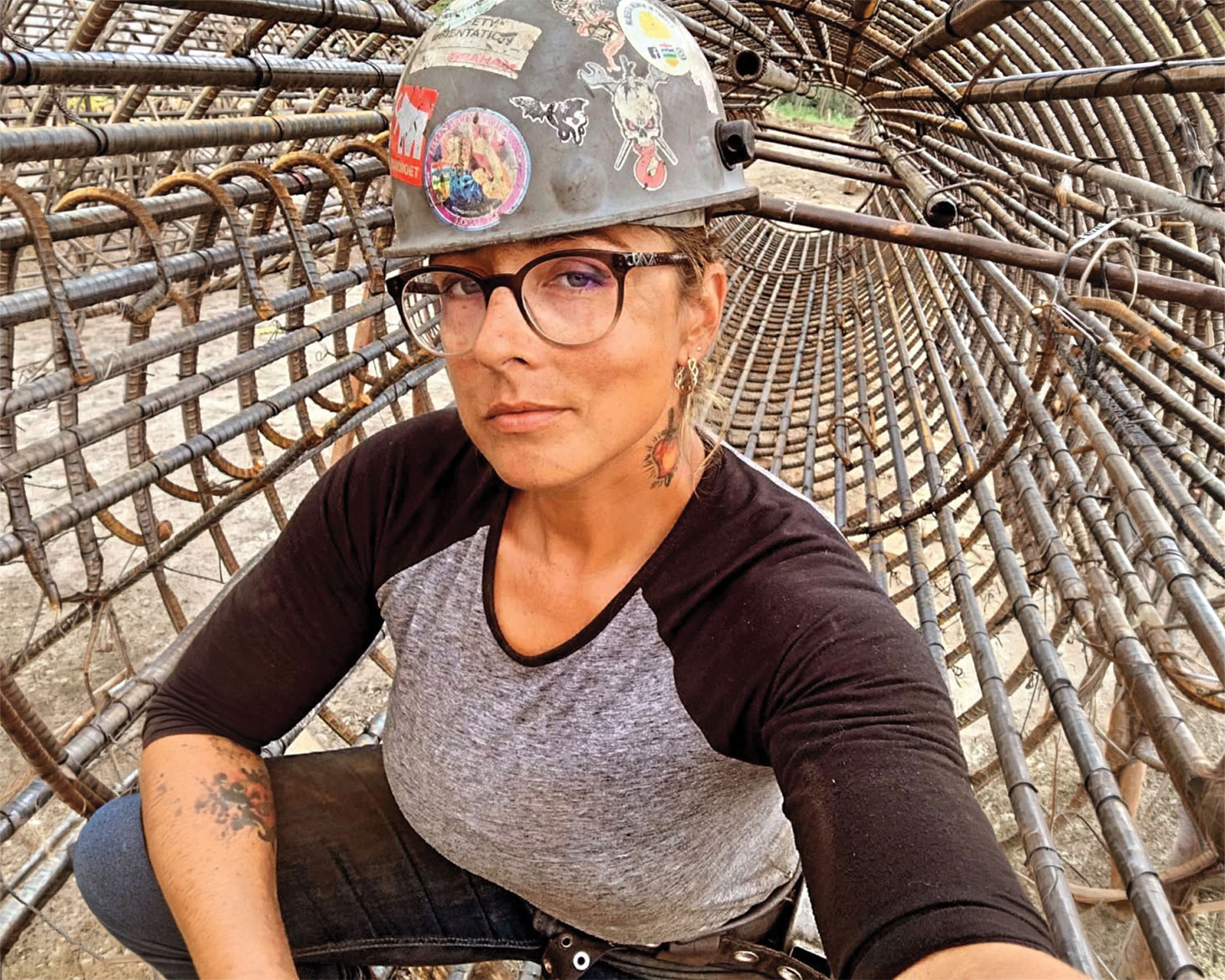
Crystal Doolittle is usually on site before her shift starts. By the time most workers arrive, the Goldbar Reinforcing foreman has already reviewed her safety paperwork, checked in with the superintendent and started planning the day ahead.
After more than 30 years in construction and more than two decades building piles, Doolittle has earned a reputation for competence, efficiency and leadership. That reputation, however, was built over years of proving herself in an industry where women remain underrepresented. Goldbar Reinforcing is a construction contracting and labour services business in Edmonton. While Doolittle loves her job and the career she has chosen, it has not been without its challenges.
“Piling is always a very fast-paced industry with a multitude of dangers around. Workers are expected to lift weight, carry it over a distance and keep up with the tasks assigned by their journeyman,” said Doolittle. “As women, we must understand our own strengths and either work to improve them or choose a different trade. The expectation is to fit in with the crew but not act too feminine. Walk fast, keep your head up, watch for danger and keep your mind on the task.
Her days often begin before sunrise and, on a typical day, she is on the road before 6 a.m. “I’m usually at work 20 to 40 minutes before my shift starts,” she said. “I start with my daily journal, talk with the superintendent and fill out my field-level hazard assessment. I say ‘good morning’ to the guys to gauge how they’re feeling mentally that day. We do our morning tailgate meeting, and then tasks are delegated to the team.”
After organizing equipment or addressing safety concerns at the foremen’s meeting, Doolittle heads back to the work area to check on progress. She makes any necessary corrections and begins placing rebar. “I still enjoy being on the tools, so I set up my days so I can work alongside the guys and not just dictate to them,” she said. “Unless it is in a plant, industrial work looks very different for a foreman. I end the day with an informal meeting about how the day went. Afterwards, I complete my paperwork for the day and proceed to get some ‘me’ time. This can mean visiting friends, going to the gym or resting with my feet up and letting the day melt away.”
Earning credibility
Doolittle says experience changes how people respond when she arrives on a new site. “With my foreman position now, I have people questioning my knowledge,” she said. “I walk in like I am their equal. I talk like I have been doing it for years, and people respect that. I am not loud, vulgar or arrogant. I work in a predominantly male workforce and respectfully know that some people need to catch up with the times.”
While she now approaches new sites with confidence, the environment she entered three decades ago was often far less welcoming. “I usually had someone calling me sweetheart, honey or some other pet name that guys like to call a girl at work,” said Doolittle.
“I could hear their backhanded comments behind my back or lewd comments about how hot they thought I was. Even when I was younger, I never let it get to me. I was one of the lucky women back in the ’90s who learned from a hardworking, honest and respectable boss. He owned his own company, and I worked for him. He eventually mentored me, teaching me everything I know. I could not show the team I was weak or emotional. I did a lot of pretending back then. Thank goodness, it got me where I am today.”
Proving herself
Throughout her career, Doolittle has encountered situations where she felt compelled to prove her capabilities to others. “For example, we carry rebar from one location to another over many obstacles and in the heat, cold, rain and wind. It is not easy,” she said.
“One specific time, I was placed at a plant as a foreman, temporarily relieving the main foreman. I gave a task to the lead hand. By Day 2, I asked him if he had answers for me so we could finish our rebar and head home. He became upset and walked down to the slab below. At that point, he started screaming at me, calling me names and acting frantically. Unfortunately, this lead hand thought he should be foreman and disliked that I was a woman doing a job he thought he was owed.”
Doolittle adds that, under today’s harassment procedures, he would be immediately removed from the site and told he could never return to the contractor’s project. “Women still have to prove their physical strength in these traditionally male trades because many people need reassurance,” she said. “There are women who can do these hard jobs long term, move up the ladder honestly and enjoy the work.”
“Women in all fields need to have a thick skin to endure the initial rush of ‘she can’t’ attitudes.”
Crystal Doolittle, Goldbar Reinforcing
While she believes conditions have improved significantly since she entered the industry, Doolittle says women often must pass a different “test” than their male counterparts. “I will always understand the strength test. This industry is physically demanding, and they need to know, just as I need to know, that we are all strong enough to do the job safely,” said Doolittle. “The test I am talking about is how men talk to one another and whether I can tolerate their daily lingo without intervening. It is absurd to even say it out loud.”
She stresses that such behaviour is not representative of all men but says some repeatedly make inappropriate comments to gauge whether she will react. “The second I get upset, things become hush-hush, and it is automatically blamed on a woman’s menstrual cycle, regardless of whether I am on my period or not,” she said. “Any other test of will, professionalism or knowledge that I have watched my male counterparts go through is what I have gone through. People will always test others to see how strong an individual’s mind and faith in themselves are.”
Doolittle says skepticism can be especially pronounced in the ironworking trade, where her expertise in pile construction is not always immediately recognize. “I’ve been in this specific market sector for well over 20 years, having built some heavy-duty cages – the biggest to date weighed 20,000 kilograms each,” she said.
“New superintendents and our clients are always a little leery of letting a woman run things until they see my competence and attention to safety. If they know me, they never question my methods. If they don’t, I’ve had superintendents discuss ‘that [expletive] woman on site’ with their crews. Until they see me perform and build piles they could never physically build themselves, they remain skeptical. Women in all fields need to have a thick skin to endure the initial rush of ‘she can’t’ attitudes. Although [as] we continuously prove ourselves to certain male figures throughout our careers, it does get easier with time.
Doolittle says assumptions about physical capability can still surface in subtle ways on some jobsites. “It’s undermining to women who like proving that we are strong,” she said. “It has always irked me when guys try to take rebar off my shoulder while I am in the middle of a pack. I understand they think they are being nice, but I have become quite angry in the past when it happened. Now it doesn’t happen.”
As a foreman, her job responsibilities have changed. She notes that physical strength is often associated with construction work, but believes that strength alone does not determine success in the industry. “Women have the drive and skill to be just as efficient,” she said. “I’ve spent years in the gym working on my strength training so I could lift all day, every day. My boss, who taught me everything, quite frequently assigned me to other tasks because I was faster and more efficient at them. Some of the guys hated this. That was their problem.”
Looking back on more than three decades in construction, Doolittle says the industry has made meaningful progress. While challenges remain, she believes future generations of women entering the trades will encounter more opportunities and fewer barriers than those who came before them.